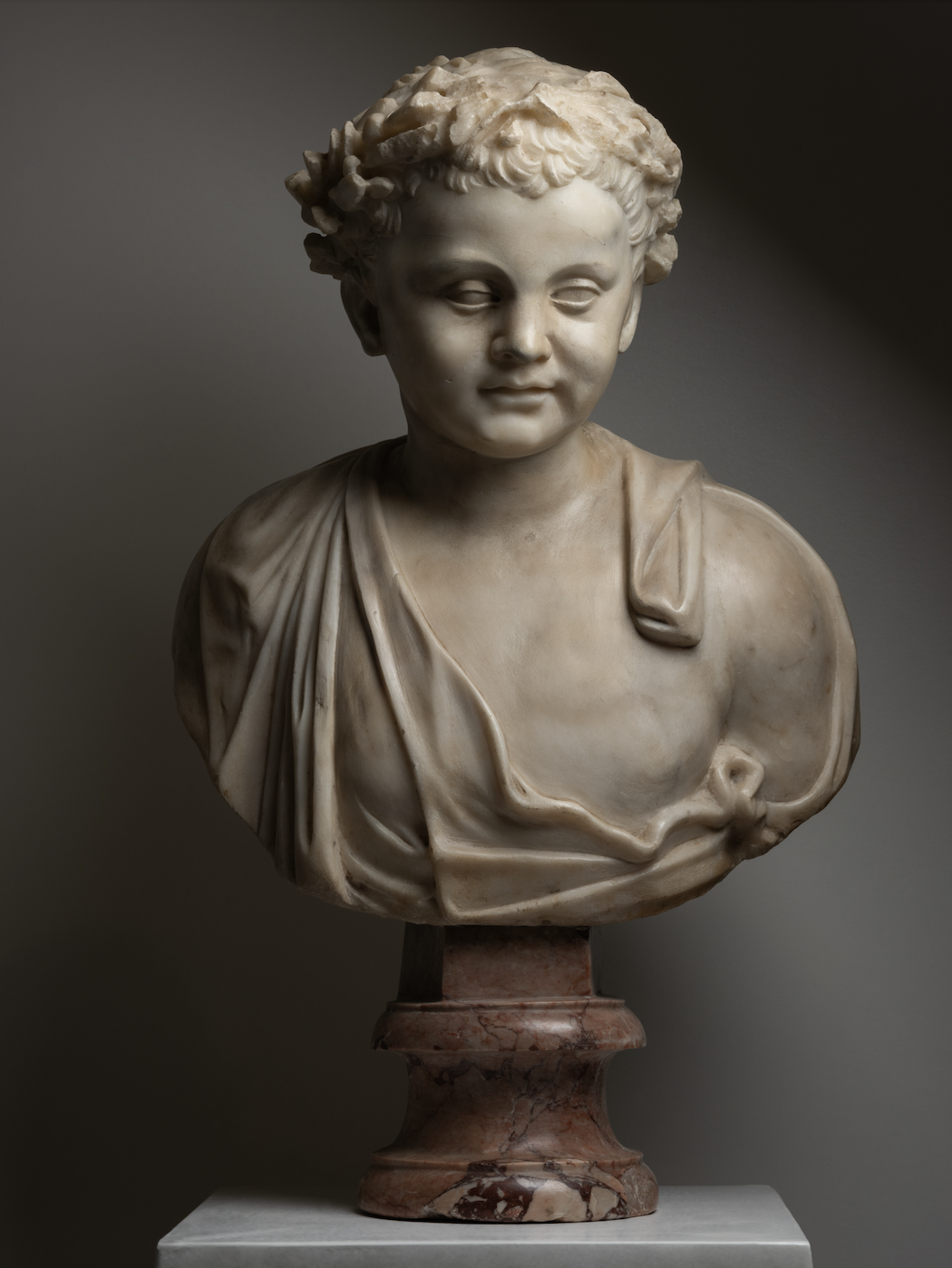
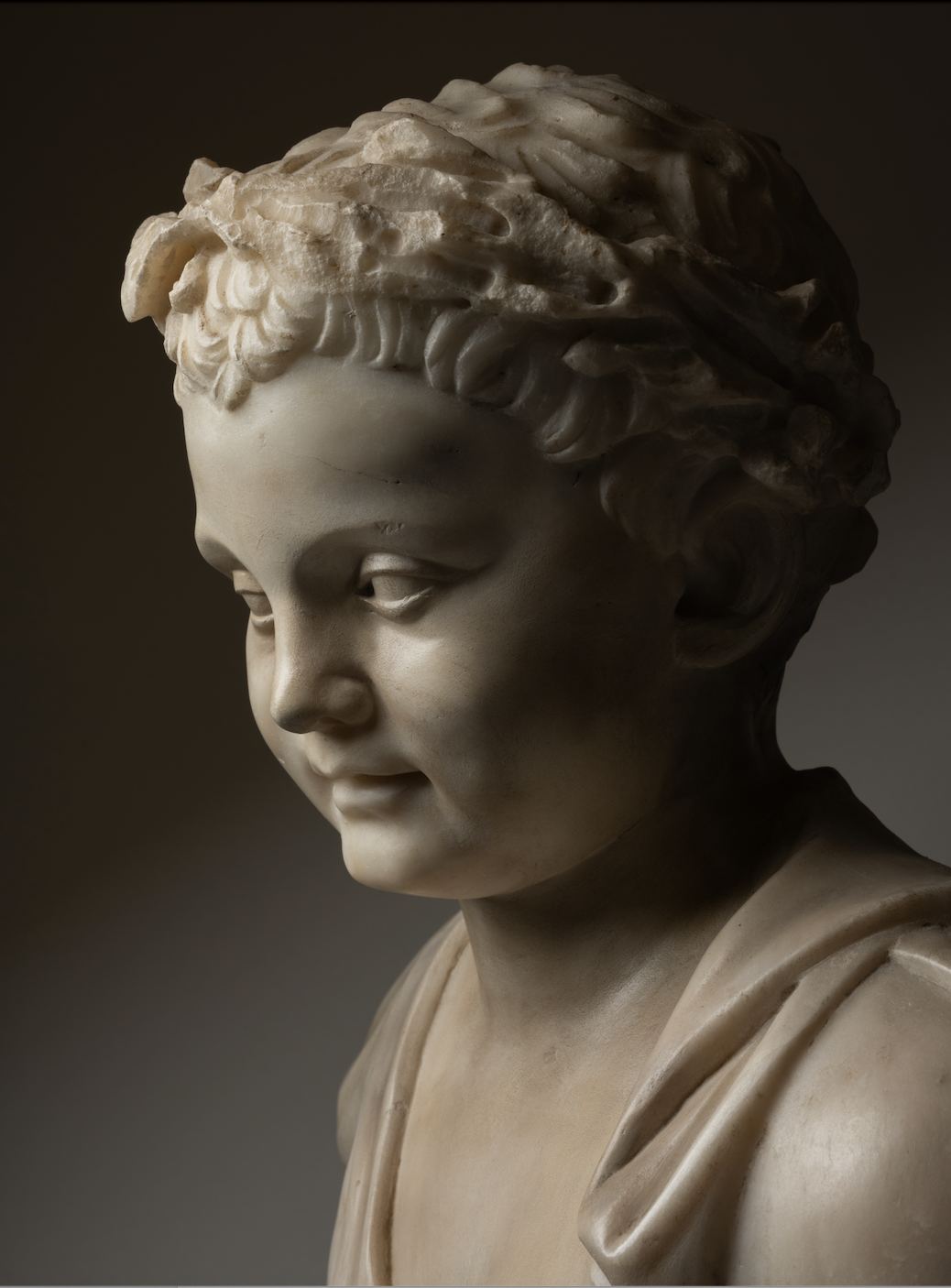
PORTRAIT OF A YOUNG PRINCE
Roman Empire, 1st Century A.D.
marble
height 58 cm | 22 3/4 in
Provenance
Reportedly from the Private Collection of Baron Mayer Amschel de Rothschild
From the Estate of the late 6th Earl of Roseberry (1882-1974), and his family Sotheby Parke Bernet & Co., Mentmore House Sale, 18th May 1977, lot 202
The present marble portrait depicts a youthful figure rendered with idealised features and crowned with a laurel wreath, suggestive of elevated rank or dynastic significance. Comparable portraits of the same young sitter are known, indicating that the subject was likely a figure of some importance, possibly a member of the Julio-Claudian imperial household. A closely related example is preserved in the Museo Archeologico Nazionale di Napoli (Infante, età giulio-claudia, c. 37–41 A.D., inv. no. 6337), while another has passed through the collection of Galerie Cahn, Basel. The existence of multiple versions of this portrait type strongly suggests an officially disseminated image, consistent with representations of imperial youth in the early Roman Empire.
The distinguished collection assembled by Baron Mayer de Rothschild in the mid-nineteenth century reflects a highly discerning appreciation for works of art and classical antiquities. A significant portion of the collection was formed through acquisitions at major aristocratic sales, notably the dispersal of the Shugborough Estate in 1842 and the Stowe House sale in 1848, both of which offered important examples of Greek and Roman marble sculpture.
The catalogue for the Shugborough sale includes several busts described simply as depicting “very fine Roman youths”; however, the absence of detailed descriptions makes any firm identification speculative. By contrast, the Stowe sale catalogue does not appear to record comparable youthful marble portraits.
These works were housed at Mentmore Towers, Buckinghamshire, the grand Neo-Renaissance residence commissioned by Baron Mayer de Rothschild and designed by Joseph Paxton in the 1850s. Conceived in the spirit of Italian Renaissance architecture, the house provided an appropriately monumental setting for Rothschild’s celebrated collection, which remained substantially intact during his lifetime before passing by inheritance to the Rosebery family.